
July 9, 2026
Wondering whether to buy raw land or a developed lot near Homer? It is a common question, especially when a property looks perfect on paper but the real work starts after you close. If you want to avoid surprises, protect your budget, and choose a parcel that fits your timeline, this guide will help you compare the tradeoffs and ask better questions before you buy. Let’s dive in.
The first step is simple: find out whether the property is inside the City of Homer or outside city limits in the Kenai Peninsula Borough. That one detail shapes who handles permits, access, and some development rules.
Inside the City of Homer, the city does not issue building permits. Instead, you may need a zoning permit before clearing or new construction, and Public Works handles driveway and water or sewer permits. If the site is in a flood hazard area, you also need a Flood Development Permit.
Outside city limits, the Kenai Peninsula Borough handles platting, utility easements, and rights-of-way. The borough says land use is generally not heavily restricted unless an overlay district applies, such as the Habitat Protection District or Floodplain District. That can sound simpler, but raw land in the borough may still require more legwork on access, utilities, and site planning.
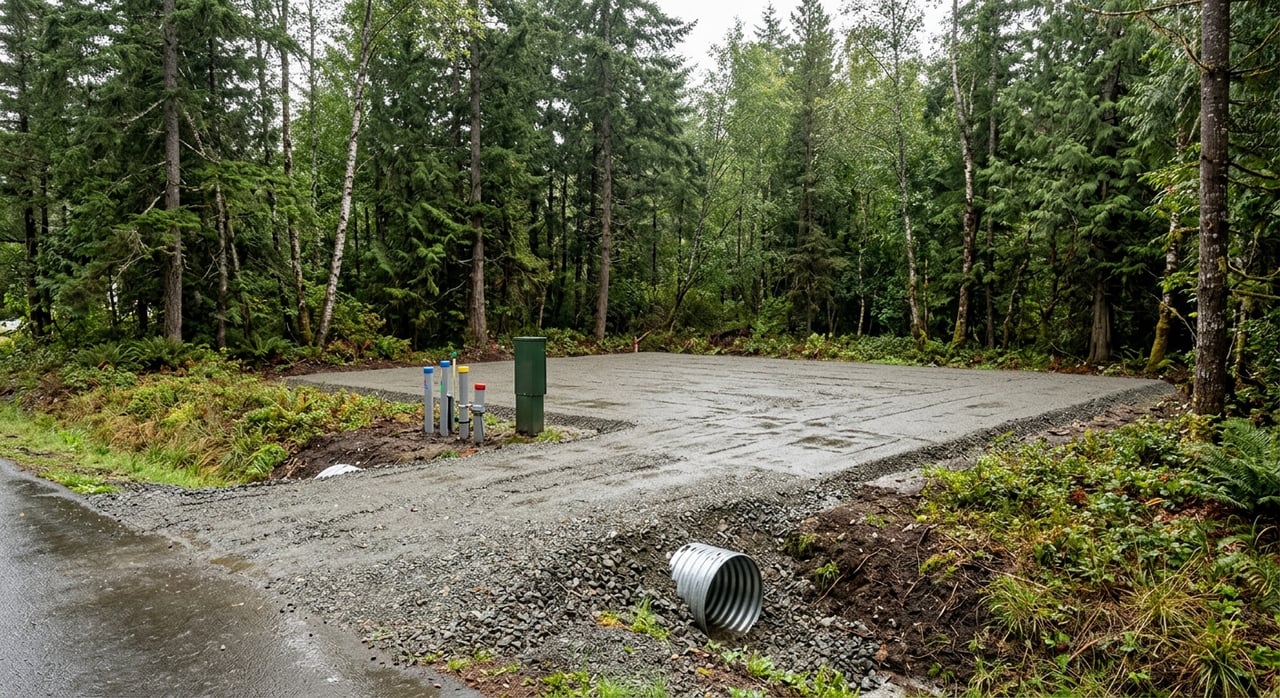
Raw land often gives you more freedom to shape the property around your goals. You may get more privacy, more acreage, or a better view corridor. But near Homer, raw land also tends to come with more front-end questions.
The biggest issue is not always the land itself. It is whether the basic pieces of a future homesite are already solved, including access, utilities, and site constraints. If those pieces are unresolved, your timeline and budget can change quickly.
A parcel is not automatically build-ready just because you can find it on a map. You need to confirm legal and physical access, and you need to know which agency controls the driveway or right-of-way work.
In the City of Homer, a driveway permit is required before work begins in the right-of-way. In the borough, driveway and other right-of-way work falls under the roads program, and the borough says there are no applicable fees to obtain ROW permits.
Road conditions also matter more than many buyers expect. The Kenai Peninsula Borough Road Service Area maintains more than 645 miles of roads, and about 95 percent are gravel while 5 percent are paved. That makes year-round access and maintenance worth checking before you assume a parcel will be easy to develop.
Power, water, and wastewater can be the difference between a manageable project and a very expensive one. With raw land, those systems may not be in place yet.
For electric service, Homer Electric Association requires the meter base to be in an approved, accessible location. The utility selects the route for a line extension, and the property owner must provide a clear and unobstructed route within the property. If the meter location falls outside standard rules, that may create additional cost.
Water and sewer are another major dividing line. The City of Homer maintains 48.65 miles of water mains and 44.70 miles of wastewater mains, so some in-town lots may be close to existing service. The city’s utility fee page lists water connection and extension fees of $300 for a single-family or duplex and wastewater connection and extension fees of $255, plus a residential deposit of $155.89, with updated rates taking effect July 15, 2026.
Outside service areas, many parcels rely on a private well and onsite wastewater system. That adds another layer of due diligence. The Alaska Department of Environmental Conservation recommends keeping the well log and making sure it is recorded in WELTS, because missing logs can complicate future real estate transactions.
A large parcel does not always mean a large buildable footprint. Wetlands, flood hazard areas, and habitat setbacks can reduce where you can build or slow your approval timeline.
In Homer, filling or building in mapped wetlands requires a U.S. Army Corps of Engineers permit. The city also notes that wetland reviews may take several weeks to a month or more. If the property is in a flood hazard area, a Flood Development Permit is required.
Outside the city, the borough’s Habitat Protection District creates a 50-foot development setback from 793 anadromous streams, lakes, and other waterbodies. If you are buying land for a specific house plan or future outbuilding, these constraints matter early.
A developed lot can be attractive because some of the early hurdles may already be addressed. That could mean road access, a driveway approach, nearby utility tie-ins, or prior site approvals are already in place.
This does not mean a developed lot is permit-free. You may still need zoning, floodplain, wetland, or driveway review depending on the site. But a lot with more infrastructure in place often reduces uncertainty compared with starting from scratch.
Inside Homer, the city provides interactive maps for roads, water distribution, and sewer mains. That makes it easier to check whether a lot is close to existing service before you move too far into the buying process.
If a lot is already served, the visible costs may also be easier to estimate. The city posts zoning permit, flood permit, and utility connection fees, which can make budgeting more straightforward than trying to price unknown site work on raw land.
Near Homer, timelines are often driven by approvals more than by construction itself. The city says zoning permit review can take up to 10 working days after a complete submittal. Conditional use permits generally add at least two months.
Wetland permitting may take several weeks to a month or more. If a site needs wastewater engineering review, DEC says plan review can take 30 days or more. A developed lot may not erase those timelines, but it can remove some of the earlier steps that trigger delays.
Here is the practical difference for most buyers: raw land offers more possibility, while a developed lot often offers more predictability.
| Factor | Raw Land | Developed Lot |
|---|---|---|
| Access | May need new driveway or ROW review | May already have access solved |
| Utilities | May need line extension, well, or septic | May be closer to existing service |
| Permitting | Often more steps up front | Still required, but fewer unknowns |
| Timeline | More likely to stretch | Often easier to forecast |
| Budget | More variable site-work costs | More visible front-end costs |
If you are flexible, patient, and planning a custom build, raw land may still be the right fit. If you want fewer moving parts and a clearer path to construction, a developed lot often makes more sense.
No matter which type of property you prefer, a few local questions can save you time and money. These are some of the most important ones near Homer.
If you might subdivide later, ask that question early too. The borough requires plat submittals to identify intended land use, existing zoning, and the proposed water supply and sewage disposal. If the plat is within city limits or the Bridge Creek Watershed Area, it must go through city planning and zoning review before borough submittal.
If your priority is control, privacy, or a custom homesite, raw land may be worth the extra work. You just need to go in with clear expectations about permits, utilities, access, and environmental constraints.
If your priority is speed, clearer budgeting, or fewer unknowns, a developed lot may be the better match. In many cases, the value is not just the land itself. It is the fact that some of the hardest early questions may already be answered.
Near Homer, the best decision usually comes down to your timeline, your risk tolerance, and how much project management you want to take on. A local guide can help you sort through those details before you commit to the wrong parcel.
If you are weighing land options in Homer or the lower Kenai Peninsula, the Buss & Turkington Real Estate Team can help you compare properties, spot red flags, and choose a parcel that fits your goals.
Stay up to date on the latest real estate trends.
Leading with our core standards and values we approach every decision with honesty and integrity. We take great responsibility in doing the right thing because it is the right thing to do.